Leo Vaicer
Early accessmacOS & WindowsFree & open source

A résumé is a file you own

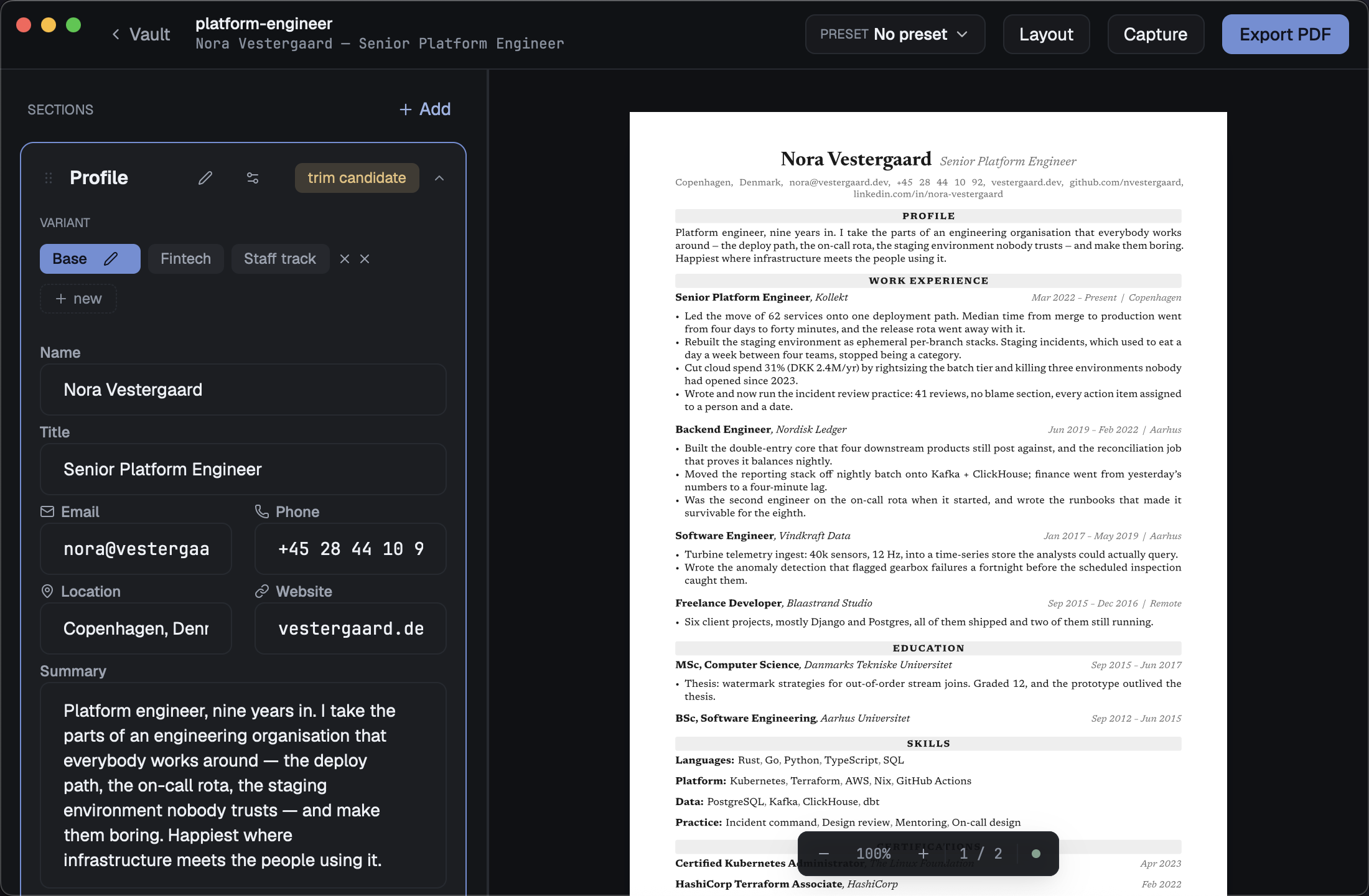
DockCV keeps your CV as plain TOML on your own disk and typesets it to a proper PDF with an embedded Typst engine. Keep a variant of each section, switch preset per application, and stop maintaining nine near-identical copies of yourself.

On Windows? There is a build for that. On Linux, the playground below runs in any browser.

  • No telemetry
  • No account
  • Works offline
  • Plain TOML

Demo video or screenshot gallery

DockCV 0.1.0 · placeholder

The part nobody budgets for

Applying to twelve places means maintaining twelve résumés

The folder fills up

cv-final.docx, cv-final-2.docx, cv-backend-v3.docx. A fix to one bullet has to be applied by hand to all of them, and eventually is not.

The layout fights back

One extra line pushes a section onto page three. You spend the evening nudging margins instead of writing about your work.

The tool holds it hostage

Your history sits in someone's database, in a format only they read, behind a subscription that wants paying before you can download it.

None of that is a writing problem. It is a file format problem, and it has a file format answer.

Run it before you trust it

The real engine, in this page

Not a video. This is DockCV's Rust engine compiled to WebAssembly, running on your machine. Edit the TOML, or flip the [work] variant between research and teaching and watch the document re-tailor itself.

DockCV engine · WebAssembly

Preview

Loads a 7 MB compiler. Nothing leaves your browser.

One document, every version of you

Tailoring, without the copies

Einstein applying for a research chair and for a teaching post needs two different CVs out of one career. Every section of a DockCV document can hold more than one version of itself — a Work section written for research, another written for teaching — each under its own name.

A preset is just a record of which version each section should use. Pick a preset and the whole CV re-typesets around it.

  • Fix a typo once and every preset has it fixed.
  • Add a role and choose which versions of you mention it.
  • One file to back up, one file to diff, one file to send yourself.
Presets — einstein.toml
researchteaching
  • ProfileBase
  • WorkResearchTeaching
  • PapersSelectedComplete
  • LecturingBriefDetailed
  • SkillsTheoryPedagogy
Presets — einstein.toml
researchteaching
  • ProfileBase
  • WorkResearchTeaching
  • PapersSelectedComplete
  • LecturingBriefDetailed
  • SkillsTheoryPedagogy
Against the real alternatives

Where DockCV wins, and where it does not

If you have never wanted your CV in a text editor, Google Docs is a perfectly good answer and this table says so.

DockCV compared with Overleaf, Google Docs, and subscription CV builders
DockCVOverleaf / LaTeXGoogle DocsCanva & co.
Where the file livesYour diskTheir serversGoogle's serversTheir servers
Works with no networkYesNoPartlyNo
Cost to export a PDFFreeFreeFreeOften paid
A version per applicationPresets, one fileCopy the projectCopy the docCopy the design
Typesetting qualityTypstLaTeXWord processorDesign tool
Reviews well in GitPlain TOMLLaTeX sourceNoNo
Machine-readable exportJSONNoNoNo
Learning curveTOML keysLaTeX syntaxNoneNone
Early access, stated plainly

What 0.1.0 does, and what it does not

Works today

  • Writing and editing a CV as a DockCV TOML document.
  • Named variants per section, and presets across them.
  • Live Typst typesetting and PDF export.
  • Importing JSON Résumé and AltaCV documents.
  • Page size, font, margins, date format, text scale.
  • Exporting the document as structured JSON.

Not yet

  • A Linux build — the code targets it, the testing does not.
  • Notarisation and Windows code signing, so the first launch needs one extra click.
  • Importing from PDF, Word, or a LinkedIn export.
  • A settled file format — TOML keys may still move before 1.0.

DockCV is built by Leo Vaicer, a systems and data engineer, mostly because the alternatives were annoying enough to be worth a compiler. The CV on this site is a DockCV document, typeset by this engine — which is the only product claim here that you can check yourself in one click.

Download
DockCV

Get DockCV

One file, no installer ceremony, no account. Everything the app needs is inside the binary — including the typesetter.

First launchNeither build is notarised or store-signed yet, so the OS asks once. On macOS, open System Settings ▸ Privacy & Security, scroll to Security, and click Open Anyway. On Windows, SmartScreen shows More info ▸ Run anyway. Once, then never again.

Stay ahead with DockCV

New builds, format changes, and the Linux port when it lands. No mailing list, because we would rather not hold your address either.

0.1.0

21 August 2026 · Free & open source

View changelog
macOSApple Silicon
Download Now

Requires macOS 11 or later

WindowsIntel/AMD
Download Now

Requires Windows 10 or later

LinuxPlanned
Watch for releases

No tested build yet. Watch the repository to hear when one lands.

FAQ

Frequently asked questions

Is DockCV really free?

Yes. It is open source under MIT or Apache-2.0. There are no paid tiers, no trial, and no fee to export your own PDF.

Do I need an account?

No. There is no sign-up, no email address, and no licence key. You download the app and open it.

Where do my documents live?

In a folder you pick, as plain .toml files. Put that folder in iCloud, Dropbox, or a Git repository — DockCV does not care and does not need to know.

Does it phone home?

No. DockCV makes no network calls: no telemetry, no font fetching, no update check. Unplug the machine and nothing changes.

The playground shows TOML, but I have heard DockCV mentions Typst. Which is it?

You write TOML. Typst is the typesetting engine that turns it into a page, embedded in the app — the same relationship a Markdown editor has with its renderer. The engine also accepts a Typst dialect directly if you want that level of control, but you never have to touch it.

Can I import a CV I already have?

If it is a JSON Résumé or an AltaCV document, yes — the importer reads both, plus DockCV's own TOML. There is no PDF or Word importer in 0.1.0; extracting structure from a laid-out PDF is a different and much harder problem, and shipping a bad one would waste your time.

How do I keep a different CV for each application?

You do not keep several files. Each section can hold named variants — a platform-flavoured Work section and a research-flavoured one — and a preset records which variant each section uses. Switching preset re-typesets the whole document. Nothing to keep in sync.

Why is the browser playground a 7 MB download?

It carries the whole Typst compiler plus the embedded fonts, compiled to WebAssembly. That is why it waits for you to click instead of loading with the page. The desktop app has no such cost — the engine is compiled into the binary.

Is there a Linux build?

Not yet. macOS and Windows builds both ship in 0.1.0. The engine is portable Rust and the UI is GPUI, which targets Linux too, but that build is not tested well enough to hand you. Watch the repository to hear when it lands.

Will the file format change under me?

It may still move before 1.0 — that is what early access means. It is TOML you can read and diff, so a migration is something you can see and reverse, not a black box.

Write it once. Send it everywhere.

Free, open source, and yours offline. No account to make, nothing to cancel later, and a plain text file to walk away with if you ever decide this was a bad idea.

Still deciding? Run the engine without installing anything.